Showing posts with label Summer Under the Stars. Show all posts

Friday, January 27, 2012

Summer Under the Stars 2011 -- Day Twenty-Six Review: Royal Wedding

I did not want to watch Royal Wedding. I'll get that out of the way up front. I only picked it because it seemed to have the best reputation of any of the movies airing for Peter Lawford (other than maybe It Should Happen to You, which I'd already seen), and because I could tell he had a prominent enough role without being the actual star. I'm not a fan of Peter Lawford. I'm not really a fan of the Rat Pack in general, although I do like Frank Sinatra in most of his solo acting efforts, and even pre-Rat-Pack, I find Lawford extremely unappealing, perpetually smarmy and boozy even when he's straight sober. I also apparently don't find him that memorable, because I didn't remember until just now, looking through a list of his other movies, that he was in the Judy Garland musical Easter Parade, which I watched only last year. (To be fair, I don't remember the plot of that movie, either, so maybe Lawford isn't the one I should blame.)

Lawford's costar in Royal Wedding, as in Easter Parade, is Fred Astaire, and the two of them are joined by Jane Powell and Sarah Churchill as their respective love interests. Astaire and Powell are the stars of the film, playing Tom and Ellen Bowen, a brother and sister dance act, which is always doomed to come off a little hinky, I think, no matter what the context -- it's weird on reality TV dancing shows, and it's weird here, especially during the opening number, in which the siblings dance as characters who definitely aren't brother and sister. Anyway, Tom and Ellen travel to England for the wedding of Elizabeth II (hence the title of the film), where Ellen falls in love with an English lord (Lawford) and Astaire falls for a fellow dancer played by Churchill, but also spends a lot of time by himself, which leads to the two most famous moments of the film and, in my opinion, the only two reasons to watch it: the first is Astaire's dance number with a hat rack, the second is his "dancing on the ceiling" number, which the filmmakers achieved by constructing a model of the room inside of a giant steel barrel and slowly rotating it. These two dance numbers, just like most of Astaire's dance numbers, stand the test of time; the rest of the dance numbers in the movie are fine, but, much like the movie itself, nothing terribly special.

Which brings me to something I've noticed about a lot of Fred Astaire's movies, which is that he often dances with women -- including Jane Powell -- who are clearly multitalented but aren't dancers in the sense that he was a dancer, or Gene Kelly was a dancer, or many of the women whom Kelly danced with in his movies (Cyd Charisse, Leslie Caron) were dancers. Astaire is often paired with actresses who learned to dance for their roles opposite him, or for movies and stage work in general; he is rarely paired with women who broke into movies because they were dancers. Even Ginger Rogers, his most frequent (and arguably best) dance partner was an actress first, dancer second, and I think the reason the two of them had so much success was because she moved perfectly with him in all ways, not because she was as skilled of a dancer as he was. Jane Powell does a fine job dancing with him in Royal Wedding, but the thing that sets her apart from other actresses is her singing voice, not her footwork. The reason I mention this is because I think the usual formula for a Fred Astaire movie is "Such-and-such actress dances with Fred Astaire," where dancing is (usually) a form of romantic coupling and he is always leading, always in control; when he dances with a woman whose skills equal his own, the effect is quite different. Take a look at his famous dance with Rogers in Swing Time versus his dance with Eleanor Powell, an experienced tap dancer, in The Broadway Melody of 1940.


Both numbers are great, but they're great for different reasons. I don't know enough about Fred Astaire to know whether he danced with non-dancers more because the studio bosses wanted him to, or because he wanted to, or because that's just how it worked out, but I find the disparity interesting, especially when you consider that skilled female dancers like Powell and Anne Miller never became as big of stars as Astaire or Gene Kelly. (I also think, after watching that Astaire and Powell clip, that Kim Novak might want to write another letter to Variety, because The Artist may have "stolen" more than the Vertigo love theme. Or maybe I've just seen the trailer for The Artist so many times that I'm seeing it everywhere.)

Grade: B-

Thursday, January 19, 2012

Summer Under the Stars 2011 -- Day Twenty-Five Review: Il Gattopardo (The Leopard)

I don't often finish watching a movie feeling like I would have benefited from a brief lesson on Sicilian history prior to starting it, but my advice to anyone planning to watch The Leopard for the first time is to familiarize yourself at least slightly with the decline of the aristocracy and rise of the middle class in Sicily during the 1860s, because that rise and fall makes up the entirety of the story in The Leopard, yet the film itself makes no attempt to explain the finer points of that history through the story. The director, Luchino Visconti, assumes we know the larger historical significance of the time period during which his film is set, and instead chooses to show how the decline of the aristocracy affects on man in particular, the Prince of Salina (Burt Lancaster), and his immediate family, including his traditional wife Maria (Rina Morelli) and his more flexible nephew Tancredi (Alain Delon). This is actually to the Luchino's credit, because it allows him to tell his story without bogging down the plot in historical detail, but it can also make watching The Leopard a confusing experience for people (like myself) whose knowledge of Sicilian history is nearly non-existent.

Fortunately, while the academic nature of The Leopard combined with the obvious language barrier (the movie was filmed in Italian, although the two lead actors -- Lancaster and Delon -- are American and French, respectively, and had their lines dubbed), the film is well-made enough to stand up to the initial befuddlement it may cause. Delon is Delon, exactly as you might expect him to be (I'm not much on early-sixties' pretty boys, including the pretty boy Visconti initially wanted for the part of Tancredi, Warren Beatty), but Lancaster is great as the Prince, full of the same quiet power he demonstrates in Judgement at Nuremberg, and Claudia Cardinale is excellent as the vivacious Angelica, striking the right balance between previously-low-class roughness and luminous beauty. The film starts off a bit slow, especially -- again -- if you don't quite understand what is going on with some of the revolutionary battles scenes, but the forty-minute climactic ball sequence that closes the film is a marvel of filmmaking, with excellent direction from Visconti and especially strong work from Lancaster. The Leopard isn't the sort of movie you want to watch when you're in the mood for something light and mindless, but it's well worth watching when you want something a bit heavier and artistic.

Grade: A-

Wednesday, December 14, 2011

Summer Under the Stars 2011 -- Day Twenty-Four Review: Cry 'Havoc'

War films about women that came out in the forties have one major leg up (no pun intended) on war films about men that came out around the same time: to put it simply, the women are allowed to hate each other. Perhaps it's because Hollywood viewed men and women so differently, or perhaps because they didn't want to confuse audiences by drawing a firm line between American soldiers and their enemies and then throwing too much inter-American conflict into the mix, but whereas the conflict between male soldiers is usually contained to big-topic disagreements about class or ethnicity (or something comparable), women in these sort of movies often dislike each other because, well, they just do. In some ways, this makes World War II films about women easier to understand today, because we're able to relate to them in a manner more intimate than history or war; it certainly helps Cry 'Havoc' and So Proudly We Hail!, two films released in 1943 that were based on the real-life ordeals of the nurses stationed in Bataan during the Japanese sweep down the Pacific during the early part of the war. Neither film pulls any punches in portraying the hardships the women face, but both also heavily concern themselves with the everyday drama between their characters.  

The main conflict in Cry 'Havoc' occurs between Ann Sothern's character Pat and...well, just about every other woman in her group of nurses, but especially Lieutenant Smith, played by Margaret Sullavan in her second-to-last film role. Pat is supposed to be a variation on the sort of tough-talking-broad-with-a-heart-of-gold Sothern frequently played during the early forties, but more often than not she just comes off as a bitch, as when she needlessly victimizes a former cosmetics saleswoman (Ella Raines) who's crumbling under the pressure of being a nurse. You see, the basic story in Cry 'Havoc' is that a rag-tag group of women have come to the island of Bataan to volunteer their services as army nurses, despite their not having any experience with medicine or the military, and Sothern's Pat has it out for just about everybody, from the fellow nurses she feels aren't rising to the occasion to the higher-ups -- like Lieutenant Smith -- who try to give her orders. Complicating matters further, she soon falls for Lieutenant Holt, the communications officer who also happens to be Lieutenant Smith's secret husband (secret because military regulations during WWII forbid fellow officers from marrying.)

Joan Crawdord allegedly turned down a role in Cry 'Havoc', dismissing it as "The Women Go to War," and she may have had a point: like The Women, the sharp-tongued 1939 comedy that costarred Crawford and explored the complex (and sometimes conniving) relationships between modern women, there are no male characters on-screen in Cry 'Havoc,' aside from a few dying soldiers; the oft-discussed Lt. Holt is only seen once, from a distance, and when he eventually dies and Lt. Smith and Pat are forced to come together in their mourning, we don't even have a face to attach to his name. This no-men gimmick works in The Women, where the way women pick at each other in regards to men is sort of the point, but in Cry 'Havoc,' it really only serves to bring the drama between the women so much into the foreground that the story consists of little else. War-related things occur, of course, and the ultimate point is that the women need to put their personal differences aside in order to be successful nurses, but when I think about Cry 'Havoc,' two things stick out to me: the women are tired (understandably), and Pat and Lt. Smith fight over a man.

So Proudly We Hail! has even more to do with war-time romance than Cry 'Havoc,' with separate storylines for lead actresses Claudette Colbert, Paulette Goddard, and Veronica Lake, and yet it manages to mix the themes of love and war together in such a way that neither finds itself trumped by the other. The nurses in Hail! are just as prone to infighting as the women in Havoc, with Lake taking up the part of the odd woman out, who won't talk with the other nurses or even let them borrow her jewelry, but in a twist from the pattern set forth in Havoc, their bickering subsides as men enter the picture (literally, since we get to see the men here) and the rigors of war become more demanding. Ironically, the more the women talk about, think about, and interact with their men, the more we see them as people separate from their men, as flesh and blood humans with distinct personalities and motives, just as in real life. When we find out why Lake's character is so hostile to the other nurses, we have sympathy for her, or at least more sympathy than we can spare for Pat in Havoc when she realizes she's been throwing herself at another woman's husband.  

Hail is the lighter of the two films but also probably the better of the two, because despite its emphasis on romantic storylines, it has genuinely exciting and well-filmed battle scenes and keeps the story moving at a brisk but never skimpy pace, utilizing flashbacks along with a few surprise twists and deaths. Havoc started as a play and feels like a play, spending an inordinate amount of time in the women's bunker, and though its ending is more nihilistic and perhaps more realistic than the ending of Hail, it has far too many supporting characters, so many that by the film's conclusion I still couldn't identify some of the characters by face or name. (Hail keeps its focus on a select few and is all the better for it.) Cry 'Havoc' is quite a good movie, with an especially good performance from Margaret Sullavan, but it never strikes the right balance between humor, romance, action, and drama, whereas So Proudly We Hail! manages to meet all the criteria of a forties' war film while still adressing the specific concerns of the women it set out to portray.

Grade: B+

Wednesday, November 16, 2011

Summer Under the Stars 2011 -- Day Twenty-Three Review: The Thief of Bagdad

I've already talked about how TCM has their quintet of actors they always feature during any of their special movie programming, but one of the nice things about Summer Under the Stars is that they also feature lesser-known (or simply less popular) actors, particularly silent screen stars who have faded from the public consciousness, like Lon Chaney and the actor I'm focusing on today, Conrad Veidt. Chaney at least has some name recognition because of his innovative makeup work and the fact that he shares his name with his son, The Wolfman, but prior to this August I had never heard of Veidt, a German actor who spent most of his career in Europe and only settled in Hollywood during the last three years of his life. And that's why I appreciate Summer Under the Stars, because as I found out, Veidt was an extremely interesting man who deserves to be better known outside of silent movie circles.


The Man Who Laughs
One of Veidt's most famous roles came early in his career, as the sleepwalking murderer in The Cabinet of Dr. Caligari (1920), where he is virtually unrecognizable under heavy makeup and jet black hair. Like Chaney, many of his movies throughout the twenties required him to obscure his features to play men existing on the fringe of society, whether as Ivan the Terrible in Waxworks or the tragic Gwynplaine in The Man Who Laughs, whose mutilated smile was allegedly the inspiration for The Joker in the original Batman comics. Despite being a big star in Germany, Veidt was virulently anti-Nazi, and after marrying a Jewish woman in the early thirties he left Germany and took up residence in Britain, where, among other films, he made the 1937 spy thriller Dark Journey with Vivien Leigh. It wasn't until 1940 that he moved to Hollywood to shoot The Thief of Bagdad (which, despite being a British film, was produced in California because of World War II); ironically, he spent much of his time thereafter playing Nazis, most famously as Major Strasser in Casablanca (1942).

Different From the Others
Veidt was characteristic of the liberal Weimar Republic that preceded the Nazi regime in Germany, during which time many of the masterpieces of German film were produced: Robert Weine's Caligari; Fritz Lang's Metropolis; G.W. Pabst's Pandora's Box; and Josef von Sternberg's The Blue Angel, among others. These films dealt with social issues that the Nazi government would later denounce as debauched or insubordinate, including the plight of the working class under capitalism and homosexuality: Veidt himself played one of the first gay characters ever put on screen (and certainly one of the first sympathetic gay characters ever put on screen) in Different From the Others (1919). He was supportive of the Jewish people and in 1934, after moving to Britain, made the anti-persecution film Jew Suss (the title of which unfortunately later gained infamy as an anti-Semitic propaganda film released by the Nazis in 1940), and like his compatriot Marlene Dietrich, he dedicated a good amount of his own time and money to helping the Allied cause during the war. He died in 1943, two years before the end of the war in Europe, making it impossible to know what his relationship would have been with his native country in the post-War period, or whether he would have moved on to playing non-German roles in Hollywood films.

With his varied life in consideration, then, it's disappointing that TCM chose to focus primarily on his work playing Nazis in war-time films, rather than exploring his work in Germany during the silent era. I almost chose to watch The Cabinet of Dr. Caligari because it was one of his few German films they did include, but in the end I went with The Thief of Bagdad because its buoyant storyline seemed more appropriate for a summer movie festival, and because it was directed by Michael Powell, who, along with Emeric Pressburger, created two classics of post-War British cinema: Black Narcissus and The Red Shoes. Like those films, The Thief of Bagdad is full of bright colors and exotic cinematography, translating parts of the Arabian Nights into a story about a king, ousted from his kingdom by an evil vizier, who teams up with a petty thief before falling in love with a princess and losing his sight to a magical curse. Veidt plays the vizier, Jaffar, while John Justin plays the ousted king and the Indian actor Sabu plays the thief Abu (and, in probably the most famous sequence from the film, Rex Ingram plays a giant genie who grants Abu three wishes in return for freeing him from his bottle; the similarities between this story and Disney's Aladdin are very much intentional, right down to the way Jafar in Aladdin greatly resembles Veidt).

The Thief of Bagdad really is, in effect, a perfect summer movie, high on beautiful scenery, visual effects, and action, but pretty skimpy when it comes to acting and character development. Veidt is far and away the best actor of the bunch; John Justin is serviceable as the king, kind of like a thinner, less charming version of Errol Flynn, but June Duprez lacks any personality at all as the Princess. (Alexander Korda, who produced the film, reportedly wanted Vivien Leigh to play the Princess, and I would have loved to see what she could have done with the part -- if anything could have been done with it.) The acting isn't really important in a film like this, though, and it's well worth watching for the vibrant photography and levity of the story lines -- as well as the chance to see Veidt in the role that kicked off the final stage of his career. My hope, however, is that TCM will highlight Veidt again in the future, with more of a focus on the work that first made him a star.

Grade: A

Thursday, November 3, 2011

Summer Under the Stars 2011 -- Day Twenty-Two Review: Sadie McKee

Every now and again, a movie will surprise me, either by being much better or much worse than I expected it to be before watching it. This happened a number of times during my big movie project last year: Caged, Tarzan the Ape Man, and Ringside Maisie were all better than I anticipated; Wuthering Heights and The Searchers were worse. Most of the time, my surprise comes from what I presume to know about certain films' genres, stars, or reputations; for example, I generally don't have much interest in Westerns, but on an individual basis I often love them, and the same goes for smaller films like Woman Wanted or Trade Winds. And it's certainly the case for Sadie McKee, a woman's film released in 1934 and starring Joan Crawford.

To say I expected Sadie McKee to be awful isn't true: I simply didn't expect it to be anything special. Women's films can often come across as melodramatic today, and while I admire Joan Crawford's screen presence and haven't ever seen her give a bad performance, I've also never connected with her the way I have with actresses like Vivien Leigh or Bette Davis. What's more, on paper, Sadie McKee seems exactly like every other women's film released during the thirties: Crawford plays Sadie, a maid who runs off to New York with her boyfriend Tommy (Gene Raymond) and then finds herself stranded when he abandons her for a traveling singer (Esther Ralston) whom he believes will further his music career. To make ends meet, Sadie becomes a dancer in a night club, where she meets and wins the favor of a millionaire (Edward Arnold) whom she soon marries and helps cure of his alcoholism. Along the way, she still pines for Tommy and spurns the "help" of her former employers' son (Franchot Tone), who conceals his affection for her by criticizing her at every turn. There is mercifully no out-of-wedlock baby involved, but the entire rags-to-riches motif is as strong here as it ever was.

What makes Sadie McKee surprising -- and surprisingly good -- is the superb cinematography, camera work and, above all else, musical selections, the latter a rare quality in a non-musical classic film. The performances are all excellent, with everyone from Crawford to Ralston shining in their parts, but what really stood out to me was the way director Clarence Brown set the mood for each scene with impeccable lighting, costuming, and set design, and then overlaid it all with unusually good music. Sadie McKee introduced the song "All I Do Is Dream Of You," which most people probably recognize in its peppier form from Singin' in the Rain, but the slowed-down version is beautiful, and the scene where Raymond first sings to the song to Crawford, in a run-down boarding house where Tommy and Sadie are staying before getting married, is a masterwork of combining image and sound to create a specific mood. I can't find that scene online, but the reprise of the song, when Sadie has already married the millionaire and hasn't seen Tommy in years, is almost as good:


The only downside to Sadie McKee, aside from the occasionally predictable story, is the fact that Crawford and Raymond don't have as much chemistry as Crawford and Tone, or Raymond and Ralston. We know from the beginning that Sadie and Michael (Tone) are going to end up together, not just because the story wants it that way but also because they have genuine electricity between them (which makes sense, as Crawford and Tone were married in real life); furthermore, although Ralston plays the film's only villain, she and Raymond click together in a way that Raymond and Crawford don't. Take a look at the scene where Tommy and Dolly (Ralston) first meet:


Granted, Ralston is not a great singer, which makes her an odd choice to play a professional singer in a movie, but she has a fun, sparkling energy that works well with Raymond, whereas most of his scenes with Crawford are romantic but deadly serious. Ralston is also styled rather unusually in this film, in that her makeup is subdued and her clothes relatively simple, giving her a naturally pretty quality that further enhances her character. Ralston was a popular actress during the silent era who found less work during the thirties, and although our sympathies are always firmly with Crawford in Sadie McKee, Ralston almost makes us understand how Tommy could leave Sadie, thereby making him more sympathetic and the ending of the film all the more tragic, as well.

Grade: A-

Tuesday, October 25, 2011

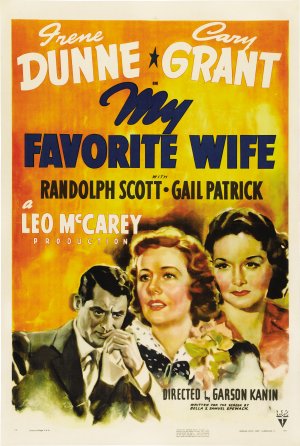
Summer Under the Stars 2011 -- Day Twenty-One Review: My Favorite Wife

I have mixed feelings about Irene Dunne, the star of the 1940 Garson Kanin comedy My Favorite Wife, in much the same way I have mixed feelings about her modern-day equivalent, Meryl Streep. I usually hate when people compare actors of today with actors of yesterday, especially when it comes in the form of "So-and-so is the next James Dean," because trust me, so-and-so is not the next James Dean, but my comparison between Irene Dunne and Meryl Streep has more to do with the breadth of their talent and the effect they occasionally have on screen. Like Streep, who has been in everything from Mamma Mia to Sophie's Choice, Irene Dunne was an extremely talented and flexible actress, moving seamlessly from romance (Love Affair) to drama (I Remember Mama) to screwball comedies (The Awful Truth) to musicals (Show Boat); of her five Academy Award nominations, one was for an epic, one was for a romance, one was for a drama, and two were for comedies. Also like Streep, she occasionally comes across like she knows she's good at whatever she tries, and some of her performances -- especially her comedic performances -- are shot through with a touch of superiority, not so much a holier-than-thou quality as a better-than-thou quality that sets her both above and apart from her films -- as well as Hollywood as a whole.

The difference between Streep and Dunne is that whereas Streep's superiority comes both from her stellar reputation and her slightly hippy-dippy, anti-Hollywood personality (anti here meaning opposite-from, not against), Dunne rose above the Hollywood hoopla by only engaging it when she felt it was necessary. Sometimes I feel like every actress I feature on this blog had an issue with Hollywood during the studio system, but while Jean Arthur, Vivien Leigh, and Margaret Sullavan professed to hate everything that went along with the process of making movies, Dunne simply treated acting as her profession, neither immersing herself in the Hollywood lifestyle nor raging against it -- and thus she was arguably the most successful actress of the era at keeping her public life and her personal life separate. She had no drama, no scandals; she was married to the same man for thirty-seven years. By all accounts, she was probably exactly the kind of person with whom I would get along in real life, but when it comes to watching her on screen, she sometimes -- not always, but sometimes -- comes off a touch removed from the action of the story -- not unwilling to participate, but with a smirky air of "Oh, yes, well, I'm awesome and dignified while acting like a fool, too."

That, in effect, was my only problem with My Favorite Wife, wherein Dunne costars with another actor I find notoriously guilty of detaching himself from his roles: Cary Grant. Grant, unlike Dunne, was the consummate movie star during the studio years, glamorous and exciting, with a carefully-crafted screen persona to boot, but the effect is the same: are we ever really watching anybody but "Cary Grant" when we watch a Cary Grant movie? He can be serious and he can be gratingly over-the-top, but he is always, always the entity we recognize as Cary Grant, so how can he be a fictional character at the same time? He can't, as far as I'm concerned. He exists apart from his characters because his characters can never match up to the sum total of his on-screen self, and Irene Dunne exists apart from her characters because they can never match up to her off-screen self; either way, what you end up with in My Favorite Wife are two professionals doing a very good job of turning their charms toward the camera, but not exactly through the filter of the script.

Fortunately, the script, the direction, and, yes, the performances of the two stars -- plus supporting work from Gail Patrick and Randolph Scott -- are good enough to make My Favorite Wife worth watching. As much as I sometimes dislike Cary Grant, his movies are almost always light, enjoyable fun, and Irene Dunne is quite charming in her role, superiority be damned. She understood, I think, that the audience would smile if she smiled, and part of the smirking quality I mentioned above comes from her realizing that of course the story is ridiculous, and of course the characters are ridiculous, so why not laugh at them even before the punchlines arrive? She plays a woman who, after being lost at sea for seven years, returns home to find that her husband has recently remarried, and her perpetual sense of amusement helps the film float along at a brisk pace, rather than getting bogged down in jealous catfights between her and the new wife (Patrick). Dunne and Grant have good chemistry, and more importantly, they seem to be having fun, which is an attribute not to be taken lightly when it comes to screwball comedies.


Grade: A-

Friday, October 21, 2011

Summer Under the Stars -- Day Twenty Review: The Misfits

One of the problems with the overexposure of cultural icons like Marilyn Monroe and James Dean is that it's easy to form an impression of them without actually seeing any of their work. An actress like Eleanor Parker might not have the everlasting fame of Monroe or Dean, but the flip-side is that she's usually judged by her work in films like Caged and The Man with the Golden Arm, rather than people presuming to know something about her based solely on what they've heard. I'm willing to bet that a good number of people who feel like they understand Monroe and Dean haven't seen any of their films -- I know I hadn't until last year, and yet I felt confident I had a grasp of their work on screen.

What I really understood, however, were their personae and reputations, which aren't always consistent with any given actor's work, especially actors as volatile as Monroe and Dean. In the case of Dean, the impression of him I had prior to watching East of Eden, Giant, and Rebel Without a Cause wasn't too terribly different than the impression I had after watching those films, but I also didn't find him nearly as moody as his reputation suggests, especially compared with his Method predecessor Montgomery Clift. The difference between Dean and Monroe, however, is that part of his reputation is that of a good actor, so it's not as surprising when you watch a film like East of Eden and realize that, yep, he is a good actor; with Monroe, the fact that she was also a good actor often gets buried under the image and the scandals and the cooing and shimmying that, admittedly, she sold just as much as the men who employed her. To watch one of her films can be an illuminating experience, because it turns out she wasn't just a winking caricature holding down her skirt over a subway vent. I watched four of her films last year -- Some Like It Hot, Gentlemen Prefer Blondes, How to Marry a Millionaire, and The Seven Year Itch -- and although there's not exactly a lot of diversity between the roles she plays in those films, she plays each of them differently and makes them all distinct characters, rather than just defaulting to being "Marilyn Monroe." This is especially important to realize because all of the roles are comedic, and I think a lot of times people think Monroe was cast in comedies simply because her image was kind of sexy-funny, but watching any of the aforementioned films quickly disproves that notion: she was cast in comedies because she understood how to play comedy -- and play it really, really well -- which is a skill not every actor has.

With the 1961 John Huston film The Misfits, Monroe received one of her few opportunities to play a completely dramatic role, and, as it turned out, the character of Roslyn in The Misfits also ended up being her last (she died in 1962). Playing a recently-divorced woman who falls in with an aging cowboy (Clark Gable) and an alcoholic rodeo rider (Montgomery Clift), none of Monroe's trademark sex-kitten mannerisms are present -- I don't know if I agree with certain people's assessment that she's "speaking in her real voice," because unless they knew her personally, I don't see how they know the voice she uses here is any more "real" than the voice she uses in The Seven Year Itch -- but she certainly speaks in a lower register in this film, without any of the breathiness that people usually associate with her, and although her sex appeal is still front and center, Huston and screenwriter Arthur Miller treat it more as a detriment than an asset here, focusing on the way it objectifies her and makes her helpless even among her supposed friends. Roslyn is the moral center of the film, clashing with the other characters as they head off to the mountains to wrangle wild horses meant to be killed for dog food, and Monroe completely embodies the skin of a woman who doesn't know what to do with herself without a man.

Even without Monroe, The Misfits is worth watching, though: Gable and Clift give excellent performances, and the entire final sequence in the dry lake bed with the wild horses is wonderfully shot and directed, capturing both the unbridled freedom of the animals and the listless thrill it gives the men to capture them. I also enjoyed the opening scene with Roslyn practicing for her divorce hearing with the woman from whom she's been renting a room (played by Thelma Ritter). In many ways, The Misfits is a nice companion piece to The Last Picture Show, in that they're both shot in black and white and follow aimless characters through stark southwestern landscapes; the scene in which Monroe's character comforts Clift's depressed drunk behind a bar is strikingly similar in appearance to the scene in The Last Picture Show when Sonny begins his affair with Ruth Popper. (I would also rate them as two of the best films I've watched for Summer Under the Stars).

Interestingly enough, only Clark Gable -- who died two days after filming finished -- liked his performance in the movie; Monroe allegedly hated both the movie and herself in it, and Clift's last words before he died in 1966 were "Absolutely not" when asked if he wanted to watch the movie on TV. The film certainly has a depressing air about it, and considering the doomed nature of the principal cast (only Eli Wallach made it out of the sixties alive), the film seems even more depressing in retrospect, but it's worth watching not only for the skillful direction by John Huston but also the performances of Gable, Clift, and Monroe, which, regardless of their own perceptions of them, are some of the finest they ever gave.

Grade: A+  

Thursday, October 13, 2011

Summer Under the Stars 2011 -- Day Nineteen Review: Divorce American Style

Good movies from the sixties often don't get the credit they deserve. Take any class on film history and one of the first things you'll learn is that many critics consider the sixties -- especially the early sixties -- to be one of the low points, creatively-speaking, in Hollywood's lifespan, for reasons too numerous to name here, although they boil down to the fact that while there a great many "fun" Hollywood films made during the early sixties, there weren't necessarily a great number of "important" films. For every Psycho, there were myriad versions of the Beach Party movies; moreover, even truly good films like The Sound of Music seemed like safe holdovers from the studio system, without any real sense of innovation. It wasn't until the late sixties, with films like The Graduate and Bonnie and Clyde, that a broad spectrum of filmmakers began taking more risks and ushering in a new era of creativity, which reached its zenith in the seventies.

That doesn't mean we should overlook the less groundbreaking movies from the sixties, however. While some of them are genuinely stupid, most of them have their own unique qualities to offer that can't be found in films from other decades. Divorce American Style is a good example of this kind of film. Released in 1967 and directed by the actor Bud Yorkin, it stars two people strongly associated with mainstream entertainment -- Dick van Dyke and Debbie Reynolds -- yet also sports a bitingly satirical script by Norman Lear, the man who a decade later would permanently change television with All in the Family. Reynolds and van Dyke play a married couple with two sons who decide to get a divorce after failing to find a solution to their constant bickering, she because she feels like he's no longer fun or interested in her, he because he feels she doesn't respect him. What they find, however, is that sometimes the results of divorce are more excruciating than the irritations of staying married, especially as she struggles to find someone new and he loses nearly all his money through court-mandated payments to support his family. Along the way they meet another divorced couple, played by Jean Simmons and Jason Robards, who are in precisely the same situation, with Robards' character so desperate for his ex-wife to remarry that he spends most of his time playing matchmaker for her.

What could easily have ended up a miserable story instead plays out as comedy in Lear's script, which, unlike Truman Capote's script for Beat the Devil, I consider the model of a light satire. The film opens with a composer climbing to the top of a hill and waving his conductor's wand to the sounds of couples bickering in houses all across town, and anybody who thinks the 2006 "comedy" The Break-Up with Vince Vaughn and Jennifer Aniston was the first to put the full horror of a long-term couple's arguing on the screen needs only to watch the first twenty minutes of this film, which features a literal symphony of barbed dialogue interspersed with pointed silence. Reynolds and van Dyke are both good in roles that cast them slightly against type, and the sequence of the two of them getting ready for bed after a big argument is notable for the lack of vanity involved, especially on Reynolds' part: she's still Debbie Reynolds, prettier than any real girl-next-door could hope to be, but as she pulls off her wig and sits in front of her mirror in nothing but a slip, scrubbing her makeup off her face, we also see that she's no longer the teenager who danced beside Gene Kelly in Singin' in the Rain.

I did have a few problems with the film -- mainly that Reynolds' and van Dyke's characters really didn't seem that great of a match, especially as he had much more chemistry with Jean Simmons -- but overall I came away feeling like it should be better known than it is, and I have to wonder if part of the reason it doesn't get a lot of credit is because, even worse than being released in the sixties, it looks like it was released in the sixties, with all the bright colors that accompany films from that era. When you look at a movie and find your eye bombarded with colors that share their names with fruits -- tangerine, lime, and plum -- you don't anticipate a highly relevant experience, and it occurred to me that the film might be taken more seriously in black-and-white or the subtler palettes of Bonnie and Clyde or Cool Hand Luke. Then again, forgoing the bright colors of mid-sixties' fashion and interior design would have also betrayed the film's setting in Any Town, U.S.A., and losing that specific sense of time and place would have done more harm than good.

Grade: B+  

Wednesday, October 12, 2011

Summer Under the Stars 2011 -- Day Eighteen Review: Grand Illusion

I've been dreading writing the review for Grand Illusion for a while now, not because I disliked the movie but because I'm not sure I have a lot to say about it. This is doubly disappointing considering Grand Illusion is supposed to be one of the great films of French cinema and a telling portrait of the French mindset right before World War II, but sometimes all those academic accolades don't make for emotionally-investing viewing, at least not for me. I said a while ago that I think it's harder to write a review for a movie I like than a review for a movie I dislike, but what's even harder is to write a review for a movie I find just adequately good -- I don't have much to say against it, but I can't exactly gush over it, either.

Obviously, I'm being a tad simplistic in saying that I have nothing to write about Grand Illusion; if the occasion arose, I could probably write a decent analytical paper on it, because it's certainly not lacking in Serious Themes -- in fact, I think part of the reason it didn't affect me more deeply than it did is because the themes occasionally trump the characters. The story is primarily one of class relations set against the backdrop of World War I; the director, Jean Renoir, not only dissects the issues of national identification and class identification in the early part of the twentieth century, he also suggests that French and German aristocrats had more in common with one another, even during wartime, than they did with the working classes of their own countries. The approaching obsolescence of the aristocracy is a major element of the film, as is ethnic prejudice and antisemitism (both increasingly relevant during Grand Illusion's release in 1937) and a more general commentary on the centuries-old relationship between France and Germany. Heavy stuff, in other words, especially for an American viewer who relies on subtitles to understand how the actors are relating to one another.

What Renoir does especially well is to show the human side of war, both through the friendship between the German captain (Erich von Stroheim) and French captain (Pierre Fresnay), and through Jean Gabin's working-class lieutenant's romance with a German farm girl. The relationship between the lieutenant and a Jewish soldier is poignant without being heavy-handed, as is Fresnay's portrayal of an aging aristocrat who realizes his world is dying and chooses to help the working-class representatives of the new order, even if he doesn't completely understand them. The plot skips around a lot, never quite settling into a uniform rise and fall, but the general uncertainty about what's going to happen next, even at the film's conclusion, works well with Renoir's message. To me, the title "Grand Illusion" speaks both to the fruitlessness of war and the especially convoluted quality of the First World War, where the entire European continent found itself embroiled in a battle that had largely grown out of complicated nineteenth-century politics. (This is one of the primary differences between World War I and World War II, when I think everyone, whether they were French, German, British, or American, knew exactly why they were fighting.) I give Grand Illusion immense credit for -- in 1937, no less -- creating a fair, non-hysterical recounting of the conflict between France and Germany twenty years earlier, even as an even larger conflict loomed on the horizon. I give Grand Illusion immense credit for being a well-made, well-directed, well-acted film in general. I just don't have much more to say about it than I already have.

Grade: A

Tuesday, October 4, 2011

Summer Under the Stars 2011 --- Day Seventeen Review: Beat the Devil

One of the stories that exists about the 1953 noir satire Beat the Devil is that star Humphrey Bogart didn't particularly like screenwriter Truman Capote until Capote twice beat him at arm wrestling, after which they maintained a mutual respect, especially as Bogart marveled at the way Capote could write scenes for the script as needed, pounding out pages while the actors stood by waiting for their lines. Which is all well and good for Capote, but for my money, the final result seems like it was written at the last minute, and I tend to agree with Bogart's later assessment that the film was one of the worst he ever made.

Beat the Devil isn't a terrible film, per se, but I'm not sure it completely works as a satire of the genre that Bogart and director John Huston pioneered -- or, if it does, it does so in a way that is lost on a great many people, including myself. The film isn't exactly funny, but that's not the problem: satires, unlike parodies, need not necessarily be funny, but they are supposed to point out the flaws in the things they're satirizing, and in that regard Beat the Devil doesn't so much satirize film noir as it does imitate it in a ridiculous way. I mean, the characters in Beat the Devil are obviously silly, stupid versions of some of the archetypes from cinema in the forties, so I don't agree with the critique that the film misses the mark so completely that it just seems like a bad noir, but at the same time it seems rather directionless, without any real point to make about its chosen subject: why are the characters silly and stupid? What is Capote trying to say? If he's just poking fun at movies like The Maltese Falcon for the sake of poking fun, then he's really doing more of a light parody, but in that case the fact that the film isn't very funny is a problem.


To be fair, parts of Beat the Devil do work, especially the scenes involving Jennifer Jones as a woman who is both more intelligent and less intelligent that she initially seems. Playing the bored wife of a vacationing Englishman, she's correct in assuming that her fellow travelers (Bogart, et al.) have nefarious plans for some uranium-rich land in Africa, but as the victim of an overactive imagination, her hunches prove to be as much romantic fancies as they are keen observations.  Jones looks a bit odd here -- she was typically a brunette, and her blond hair in this movie washes her out and makes her face look too shiny, and rather like she can't close her lips over her teeth -- but she's the only actor who seems to be having any fun in her role, and the only one who seems confident in the way she's playing her scenes. You know a satire isn't working when the actors appear just as unsure of its intentions as the audience.

Beat the Devil is the sort of film that would probably benefit greatly from a second viewing, because once you realize the story isn't going anywhere (and was never important in the first place), I suspect it would be easier to sit back and take in the satirical aspects of Capote's writing. The film has certainly gained a cult following in the years since its release among people who consider it both brilliant and misunderstood. I would suggest that the "misunderstood" aspect comes from the muddled message, but I'm also willing to admit that the film has some artistic merit that I'm just not seeing.

Grade: C

Monday, September 26, 2011

Summer Under the Stars 2011 -- Day Sixteen Review: The Effect of Gamma Rays on Man-in-the-Moon Marigolds

Movies adapted from plays are often at a disadvantage because their source material is necessarily less mobile than an average film script. Plays tend to have fewer scene changes and far fewer set changes than films because the logistics of changing sets during a live production are much more difficult than one in which all you have to do is turn off the camera and wheel it over to a different portion of the sound stage, which is why the theatrical world often puts more emphasis on acting and writing than on the purely visual aspects of their presentations. Plays and films are similar but not identical artistic mediums, and just as it would be impossible to put an action-heavy movie like Titanic on the stage, putting a dialogue-heavy play on the screen requires a director with the skill to create his own visual style to accompany the script; otherwise, you end up with a disconcertingly claustrophobic, sometimes even motionless film. (This is one reason I hate the screen adaptation of Arsenic and Old Lace, which takes place almost entirely in one room; the other reason is Cary Grant's manic performance.)

In this respect, at least, The Effect of Gamma Rays on Man-in-the-Moon Marigolds is a successful film, because despite its theatrical origins it feels neither static nor claustrophobic, even as it follows a woman living an extremely static, claustrophobic life. Starring Joanne Woodward and directed by Woodward's husband Paul Newman, Gamma Rays tells the story of a bitter, resentful widow named Beatrice Hunsdorfer, raising her two daughters in 1970s Connecticut, her only sources of income being her job as a telemarketer and the room she rents to an elderly tenant whose own family no longer wants to take care of her. Roberta Wallach plays Beatrice's older daughter Ruth, a loudmouthed brat favored by her mother, though possibly only because of her undiagnosed epilepsy; Nell Potts, the real-life daughter of Newman and Woodward, plays Beatrice's younger daughter Matilda, an intelligent, timid girl who bears the brunt of her mother's wrath. The three women, plus the elderly tenant, live together in a dilapidated house where much of the story takes place, but we also see the characters in other settings -- Matilda at school; Beatrice shopping for wigs; Ruth on a date with a boy she likes -- which helps give some scene variation and allows the script to feel equally natural as a film. Unlike in the play, we also get to see and hear from some of the other people in the characters' lives, such as Matilda's science teacher Mr. Goodman, who mentors her and for whose class she devises the project from which the play derives its name, an experiment in which marigolds are exposed to differing levels of radiation.

Where the film stumbles is in its presentation of Beatrice's character. Woodward gives a bravura performance in the role, which is a real departure from her work in films like The Long, Hot Summer and even her Oscar-winning role in The Three Faces of Eve, but as horrible and oppressive as Beatrice is, I got the feeling that the very last piece of her character, the one that takes her from being just awful to truly abusive, somehow got neutered in the transition from stage to screen. Because Woodward is the star of the film and the character with whom we spend most of our time, we end up feeling more sympathetic toward her than we might if we saw most of the film from Matilda's point of view -- ironically, Woodward's powerhouse performance almost ends up winning us over, even as we recognize that she's a bad mother and the film ends with her killing Matilda's pet rabbit. It doesn't help that some of the worst aspects of Beatrice's character in the play don't even make it into the film; she's an occasional alcoholic in the film, but not a drug addict, and we never see her physically abusing the girls, although we do see her cradling her eldest daughter during one of Ruth's epileptic attacks.

As portrayed by Woodward, Beatrice is not a nice woman in any way, shape or form -- and Woodward has since said that playing such a spiteful character, especially in the presence of her real-life husband and daughter, put undue stress on all of them -- but I do wish Newman had shifted the focus of the film a bit more toward Matilda's character so that we might see the full effect of Beatrice's cruelty. Nell Potts strikes the perfect balance between shyness and self-reliance in portraying Matilda, and while I think having Woodward be the star of Gamma Rays was the right decision, both Potts and Roberta Wallach take the film to a new level by fully demonstrating the differing results of living with a radioactive mother.

Grade: B+ 
  

Wednesday, September 14, 2011

Summer Under the Stars 2011 -- Day Fifteen Review: Laugh, Clown, Laugh

Legend has it that Peter Bogdanovich chose to film The Last Picture Show in black-and-white because his friend and mentor Orson Welles advised him that black-and-white film worked better for "actors' pictures" -- that is, films where the acting is front and center, rather than being a function of the grander story. To apply that rule to all films would obviously be a mistake, but I think Welles had a point: color can enhance a film, but it can also act as a distraction, especially when "color" refers to the vivid Technicolor of the pre-1965 period. In some cases, the type of film used makes a big difference -- color works better for epics like Reap the Wild Wind, while black-and-white is almost a necessity for noirs -- but more often than not, color vs. black-and-white simply emphasizes different aspects of the movie as a whole, and black-and-white can be more affective in highlighting an actors' presence, and in picking up tiny nuances that color might obscure. (I don't think it's a coincidence that the idea of "movie stars" started to fade as soon as black-and-white fell out of favor.)

The 1928 silent film Laugh, Clown, Laugh came out seven years before color film began to be widely used, but Welles's theory holds true nonetheless, in that Clown is very much an actors' picture and the black-and-white photography serves to highlight the masterful work of its lead actor, Lon Chaney. Chaney is recognizable to most people today through his work in 1925's The Phantom of the Opera, but in fact he was an accomplished actor and makeup artist throughout the twenties, leaving his mark on a number of critically-respected silent films and becoming somewhat emblematic of the silent era itself, dying in 1930 of a throat hemorrhage (he made one sound film, 1930's The Unholy Three). In Laugh, Clown, Laugh he plays a traveling performer who adopts an abandoned child and raises her as his daughter, only to fall in love with her as she nears adulthood. Loretta Young plays the girl, Simonetta, while Nils Asther plays Count Ravelli, a reckless young man who steals her heart while Chaney's character pines for her in secret. 

Loretta Young was herself only 14 when she played the part of Simonetta, and she is both lovely and startlingly childlike, even when compared with roles she played just a few years later in films like Midnight Mary and Platinum Blonde. Chaney, by comparison, was 45, and it's a credit to him more than anyone that the potentially icky nature of the story never comes across that way on screen, even as his character Tito descends further and further into depression both from guilt and the pain of unrequited love. I got the feeling sometimes that the film wasn't quite as tragic as it wanted to be, but it is sad, and like many pre-Code films, wasn't afraid to go out on an unhappy note (although a happier ending was shot). I would also be remiss not to mention that an additional benefit of using black-and-white film is the mystery and beauty associated with colorless photography, evident not only in black-and-white films but promotional portraits as well. People never look quite so beautiful, or handsome, or sophisticated as they do in black-and-white photographs, and for movie stars, that's an asset not to be taken lightly.


Grade: B  

Summer Under the Stars 2011 -- Day Fourteen Review: The Wolfman

I've been putting off doing a review for the 1941 horror film The Wolfman for a good while now because it seems like every time I sit down to write one, whatever angle I've come up with to act as an intro seems inconsequential within a few sentences. Yes, the titular monster in The Wolfman is one point in the horror movie trinity of the 1930s and 40s -- the other two points belonging to Dracula and Frankenstein's monster -- but while the latter two characters starred in pre-Code films with some serious cinematic clout, Wolfy didn't get his turn in the sun until a full decade later, right smack in the middle of the Code's heyday, thus depriving The Wolfman of its teeth. It's a horror movie, alright, but one set in a bucolic Welsh village where the deaths all occur just off-screen and the main character spends more time flirting with a shop girl than he does roaming the countryside.

Likewise, I could talk about how The Wolfman hearkens back to the days when monsters were just monsters, before they had feelings, before they were objects of love, lust, or sympathy -- before Twilight; before True Blood; before Buffy. The problem is that love and sympathy are just as much a part of The Wolfman as they are any of those modern examples, because love and sympathy are part of the werewolf mythology as a whole: werewolves aren't necessarily "bad," all the time; they simply become something bad during the full moon. If you want to look at monster folklore through the lens of human psychology, and vampires represent our urge to give in to evil without remorse, then werewolves represent our tendency to do bad things and then feel really guilty about it afterward. A werewolf is still human most of the time, remember.

Finally, I could mention that many of Hollywood's golden-age horror movies had rich literary bases, stories that started on the page and then often moved onto the stage before landing on the screen, but again, The Wolfman is the exception here, not the rule: while Dracula and Frankenstein were based on novels by Bram Stoker and Mary Shelley, respectively, The Wolfman was partly based on European mythology that dated back to the Middle Ages and partly based on innovations of writer Curt Siodmak's own imagination. The film's oft-repeated poem -- Even a man who is pure in heart / and says his prayers by night / may become a wolf when the wolf bane blooms / and the autumn moon is bright (changed to "and the moon is full and bright" in later versions) -- did much to popularize our modern perception that werewolves only come out during full moons, but it was as much an invention of Siodmak as the rest of the film.

In the end, I don't have much to say about The Wolfman except that, as far as classic horror films go, it's not the worst Hollywood had to offer, but it's not the best, either. Starring Evelyn Ankers and Lon Chaney, Jr. (not to be confused with his more famous father), it's really a "B" picture dressed up with a few "A" picture frills, most notably the presence of Claude Rains and some legendary (if strange) makeup work by Jack Pierce. Because the film tops out at just 70 minutes, we don't get a lot of time to get to know the doomed character Larry Talbot (Chaney), nor care about his romance with shop girl Gwen (Ankers). Maria Ouspenkaya and Bela Lugosi are great as a pair of eccentric gypsies, but Lugosi is also at the center of the film's biggest plot gaffe: why does his character, as the original werewolf in the film, change completely from a man into a wolf, yet Chaney's character's transformations leave him as the half-man/half-wolf hybrid we recognize as "The Wolfman" today? I mean, I understand why in terms of the story -- the moment when Larry Talbot gets bit hinges on the idea that he believes his friend is being attacked by a regular old wolf, not a monster -- but they don't ever attempt to explain this discrepancy within the story, which is one of those betrayals of the suspension of disbelief I talked about before. I'll buy that a man can change into a wolf, but when you start getting into degrees of wolfiness for no apparent reason, that's when you lose me.

Grade: B-

Side Note: The Florence + The Machine song "Howl" uses the the poem from The Wolfman in its last verse.

Thursday, September 8, 2011

Summer Under the Stars 2011 -- Day Thirteen Review: The Shop Around the Corner

Contrary to what many people seem to believe, film remakes are neither a modern innovation nor always a terrible idea, even as crappy remakes like The Heartbreak Kid (2007) and The Women (2008) seem to point to the contrary. Hollywood studios have always recycled films; if anything, we have more reverence for "originals" today than they did seventy years ago, when producers thought nothing of remaking films that had come out less than ten years before. Think of Waterloo Bridge (1931 and 1940); When Ladies Meet (1933 and 1941); and The Unholy Three (1925 and 1930). In many of these cases -- Waterloo Bridge is a good example -- the remake is generally considered better than the original, either because filmmaking techniques had advanced or because the story had enough clout from the first time around to attract bigger actors, writers and directors. I don't mean to suggest that all remakes are better -- just look at Weekend at the Waldorf (1945) and Grand Hotel (1932) -- but I am suggesting that remakes, in and of themselves, are not inherently a bad idea. They simply become bad ideas when producers choose the wrong films to revisit.

And what are the wrong films, exactly? I would argue that anything iconic (Gone with the Wind; Casablanca) is a no-go, as is anything that is very story-driven, with a specific time and place that are essential to the plot (Psycho). I think studios should avoid films that are intrinsically tied to their original stars (Astaire and Rogers musicals), as well as films that made a strong cultural statement (The Graduate). Why anyone would want to touch films that are generally loved and lauded in their original forms (Now, Voyager) is a mystery to me. That being said, there are a number of films I do think are ripe for remaking, particularly films that weren't very good the first time around (this is why the Ocean's Eleven remake worked so well) or films whose stories suddenly seem relevant again, though in a different way (I think the WWII drama The Best Years of Our Lives could act as the basis for a great post-9/11 film). In general, films with simple plots are the easiest to remake, because the rest of the story can be flipped and stretched and changed in such a way that the new film almost becomes its own entity, the much-seeked and but rarely-attained "reinterpretation."

Think about it in terms of literature: Romeo and Juliet has been told a hundred, maybe a thousand, times over because at its core its plot is nothing more than "Boy and girl from feuding families fall in love." The rest of the story -- the plague; the apothecary; the Capulets and the Montagues -- is incidental. Maybe the families aren't families, but countries; maybe they're spaceships; it doesn't matter. As long as you retain the plot, the way you choose to tell the rest of the story is up to you -- you're still "remaking" Romeo and Juliet (or, rather, the myths and stories that preceded and undoubtely inspired Shakespeare). This is what people mean when they say "universal plot," and it's the real reason it would be a terrible idea to remake something like Gone with the Wind: the plot is not simple, and even when reduced to its simplest terms, it is extremely specific -- you need the Civil War; you need Tara. The only reason to remake a movie like that is because you believe the original is somehow lacking, and that you could do better, and if that's the case...well, good luck.

The Shop Around the Corner, released in 1940 and directed by Ernst Lubitsch, is a good example of a film that does stand up to a remake, and in fact has been remade twice already, as a musical starring Judy Garland in 1949 (In the Good Old Summertime), and as a romantic comedy starring Tom Hanks and Meg Ryan in 1998 (You've Got Mail). The Lubitsch version is itself an adaptation of a 1937 play by Miklos Laszlo entitled Parfumerie, and the plot could not be simpler: two people (James Stewart and Margaret Sullavan) hate each other by day even as they're unwittingly falling in love as pen pals. That's it. The fact that in The Shop Around the Corner they happen to be coworkers living in Budapest during the Christmas holidays is irrelevant to retelling the story, though those details certainly make the film more enjoyable to watch. It might not really matter that The Shop Around the Corner is set in Hungary -- the location certainly doesn't affect the story in any way, evidenced by In the Good Old Summertime's location in Chicago and You've Got Mail's location in New York -- but it gives the film a distinctive atmosphere, as if everything we're seeing is taking place inside a snow globe right before someone tips it upside-down.

Much of the film's magic rests on the shoulders of Stewart and Sullavan, a frequent onscreen couple who also appear together in Next Time We Love (1936), The Shopworn Angel (1938), and The Mortal Storm (1940). They're an unusual pair in that MGM didn't attempt to capitalize on their chemistry by casting them in the same parts over and over again; rather, each of the four films they made is unique, and generally does not end with the two stars in a loving embrace -- The Shop Around the Corner is the exception here, not the rule. I'm ambivalent toward Stewart -- I like most of his films, and I think he's a good, though repetitive, actor -- but I love Sullavan, who preferred stage work and made relatively few films but has shone in every single one I've seen. She grounds The Shop Around the Corner -- she makes it real -- yet simultaneously elevates it through her soft eyes and distinctive voice; she plays comedy without once resorting to battiness, a real feat for an actress of her generation, and she makes us feel every ounce of longing and disapointment hidden in the barbs she shoots at Stewart's character. I don't know that I'd call The Shop Around the Corner my favorite of her collaborations with Stewart -- The Shopworn Angel is a lesser film, but one I found more affecting overall -- but it is certainly a wonderful film, and one that I think could be remade ten times over, whether it's set in China or in the middle of Small Town, USA (speaking of things that exist in a snow globe).

Grade: A

Friday, September 2, 2011

Summer Under the Stars 2011 -- Day Twelve Review: Midnight

Screwball comedies are a sketchy business, as far as I'm concerned. They're the direct precursor to our modern romantic comedies, and like romantic comedies, when they work, they work really well -- but when they don't work, they can be excruciating. The best screwball comedies, like the best romantic comedies, either take the tried-and-true scenarios of comic misunderstanding and turn them on their heads, or elevate them through superb writing, acting, and directing, so that the tropes of the genre seem fresh and charming rather than cliche. Bad screwball comedies, like bad romantic comedies, end up seeming like the same tired story rehashed over and over again, often with the same small group of actors: in the case of screwball comedies, that story is some variation on rich girl/boy + poor boy/girl = wackiness, with rapid-fire dialogue and a zany heiress thrown in to boot; in romantic comedies, it usually involves a driven career woman with no time for love and a outwardly douchey/inwardly awesome guy who teaches her how to loosen up. (Feeling sick yet?)

I didn't know what to expect going into Mitchell Leisen's 1939 screwball Midnight. On the one hand, Leisen was a director with a gift for comedy, and the cast, which includes Claudette Colbert, John Barrymore, and Mary Astor, is top-rate, full of "actorly" actors who play comedy as seamlessly as they do drama. On the other hand, the script is by Billy Wilder, who I sometimes find brilliant and sometimes...don't (see Irma La Douce), and the filming was notoriously rocky, with Colbert refusing to be shot from her right side (she thought her nose looked funny from that angle), Leisen trying to disguise the fact that Astor was seven months pregnant (which her character was not), and Barrymore so far down his slide into alcoholic oblivion that he had to read his lines off of cue cards. Throw in the fact that I found costar Don Ameche off-putting and smarmy in the revered comedy Heaven Can Wait (1943) and the odds definitely seemed stacked against Midnight's favor.

Fortunately, I didn't have any reason to be worried. Midnight is one of the best screwball comedies I've ever seen, if not the best. The story is familiar enough to be called typical of the genre, but it's also unique enough to stand on its own: After showgirl Eve Peabody (Colbert) arrives in Paris without a dime to her name, she quickly befriends the wealthy Georges Flammarion (Barrymore), who agrees to pay for all her expenses if she'll do her best to steal away his wife's not-so-secret boyfriend, Jacques Picot (Francis Lederer). Along the way, Eve meets cabby Tibor Czerny (Ameche), whose name she adopts as she drives a wedge between Jacques and Madame Flammarion (Astor), posing as Baroness Czerny, wife of a Hungarian diplomat. (The title "Midnight" refers to the story's similarities to Cinderella, and that at any moment, Eve's coach might turn back into a pumpkin.) From there, the screwball aspect really kicks in, especially after Tibor decides he's in love with Eve and travels to the Flammarions' estate to retrieve her.

As Eve, Colbert is better than I've ever seen her, and I was equally impressed with Ameche (no smarm in this role), Astor, and Barrymore, who may not have been able to remember his lines, but could still deliver them with flare. Another stand-out is the supporting actor Rex O'Malley, whose character Marcel has some of the best lines in the movie. Unlike a lot of my favorite screwball comedies, which I simply find entertaining, I actually found Midnight funny, especially the sequence in which Eve tries to convince her new rich friends that Tibor (now posing as her husband the Baron) is insane. I would recommend Midnight as a great starter film for people who are unfamiliar with screwball comedies, especially over a more famous example like Bringing Up Baby, which becomes increasingly shrill with every new twist of the plot.

Grade: A+