Showing posts with label Battle of the Blondes. Show all posts

Thursday, March 8, 2012

"Battle of the Blondes" Round Nine: Grace Kelly vs. Kim Novak


One of the commonly used cliches to describe Grace Kelly is that she was "the quintessential icy, Hitchcock blonde," referring to the feminine model that Hitchcock forged in many of his films during the fifties and early sixties. Kelly, in addition to playing the blond lead in Hitchcock's To Catch a Thief, the film I chose to watch for Battle of the Blondes, also filled that role in his Dial M for Murder and Rear Window, and I do not dispute the widely-accepted allegation that Kelly was Hitchcock's favorite leading lady, or that others, like Hitchcock himself, found her to be ideal expression of his vision; what I have always disputed is the notion that Kelly is in any way "icy." Grace Kelly, to me, is not icy. She has a coolness about her, yes; a pristine quality; occasionally even a closed-off aura that puts her on a pedestal; but to call her icy? Or cold? No. I just don't see it. Gene Tierney is icy. Katharine Hepburn is icy, except when she's around Spencer Tracy. Joan Crawford can be icy, albeit in a different way. But Grace Kelly is not icy.

I don't say this in some misguided attempt to "defend" Grace Kelly. The truth is, I don't particularly like Kelly, and if I did find her icy, I might be more inclined to find her interesting. As she is, I find her rather bland. I've liked her well enough in some roles, like The Country Girl, and I've hated her in others, like Mogambo, where she both pales in comparison to her costar Ava Gardner and to Mary Astor, who played her part in the original version of the film. As for her projects with Hitchcock, I've been fairly ambivalent: she's good in Dial M for Murder, and she's an appropriate puzzle piece in the masterwork that is Rear Window, but I thoroughly disliked her in To Catch a Thief the first time I saw  it, which is part of why I chose to rewatch it for Battle of the Blondes; the other reason is because I sort of disliked the movie itself, and as it has such a good reputation among film critics, I thought I ought to give it a second chance. Well, I did like it better the second go round, although I still wouldn't rate it among my favorite Hitchcock films, and I liked Kelly better in it as well, but I was also struck by how... unimportant Kelly's character is to the development of the film, which only reinforced my impression of her as very pretty window dressing. Yes, her fireworks scene with Cary Grant is probably the most famous from the film, but when you actually look at the story itself, all it would take is moving a few things around and you don't need her character at all; the same could be said for her character in Rear Window. This is not Marion Crane in Psycho, or even Carol Fisher in Foreign Correspondent. Frances Stevens in To Catch a Thief is only essential if you're impressed by Kelly's on-screen magic, and because I'm not, well, you can see my difficulty.

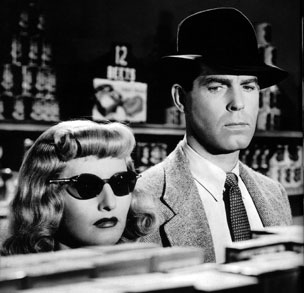
To me, Kim Novak is a much better example of an icy blonde, not because she lacks warmth but because she always seems to be holding something back, both as the characters she plays and as an actress, to the point that I agree with Hitchcock's post-Vertigo assessment wherein he said something to the effect of, "You feel like you're getting a lot [from her]... but you're not." Novak is beautiful, obviously -- even more beautiful, I would argue, than Kelly -- and she has a captivating screen presence, and in her first major film role in the 1954 noir Pushover, playing a gangster's girlfriend who seduces the detective (Fred MacMurray) assigned to keep an eye on her, I didn't have any trouble accepting her as the sort of woman who would tempt a man into  throwing away his life. The problem is that if you scratch the surface of Novak's characterization, I'm not sure there's enough there to merit a man actually ruining his life, especially when you compare Pushover to the film that clearly inspired it, Billy Wilder's classic Double Indemnity, which also stars Fred MacMurray and has Barbara Stanwyck in the femme fatale role. Stanwyck was an actress who always delved deeply into her roles, and (in addition to the fact that she was working with a superior script) she makes you believe that she could lead a man to ruin, even if she's not as glamorous as Novak and sports one of the worst hairstyles in movie history.

All the same, I like Novak in movies like Bell, Book and Candle and The Man with the Golden Arm, and between Kelly and her, I'm always more excited to see her, although I know I'm probably in the minority with that opinion. And, regardless of my feelings on Grace Kelly, I think ending the Battle of the Blondes showdowns with her was a good idea, just as I think starting with Marilyn Monroe was a good idea; more than anybody else, they are the two quintessential blondes of the classic movie era, and any consideration of blondes on film would be incomplete without them.

To Catch a Thief: B+
Pushover: B   

Wednesday, January 11, 2012

"Battle of the Blondes" Round Eight: Julie Christie vs. Diana Dors


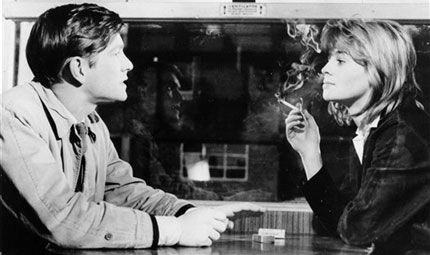
The eighth showdown in Battle of the Blondes, between British actresses Julie Christie and Diana Dors, was a nice lesson on how to make the most of a small role in a film... and how not to. In both cases, neither actress has the lead role in her respective film (Billy Liar for Christie and An Alligator Named Daisy for Dors), but whereas Dors -- who actually had the larger role, comparatively speaking -- took her part and turned in an adequate but thoroughly unmemorable performance, Christie manages to take her roughly ten minutes in Billy Liar and almost steal the picture from lead actor Tom Courtenay. This may seem unsurprising, considering Christie is thought of as a bona fide "actress" who still wins accolades for her performances today, while Dors is often lumped in with other fifties' sexpots, but remember that fellow sexpot Jayne Mansfield turns in an extremely memorable performance in Will Success Spoil Rock Hunter?, as does Marilyn Monroe in any number of her films. The issue at hand here is not Christie's and Dors' overall careers but the way they handled their roles in two specific films.

What helps highlight Christie's and Dors' performances is that both Billy Liar and An Alligator Named Daisy are okay, but not great, films; in other words, their ability to make a mark on the minds of the viewer rests entirely on their own shoulders, and not on the shoulders of a particularly skilled writer or director. Billy and Daisy are quite different in their own rights, the former an example of Britain's late-fifties/early-sixties "Kitchen Sink Realism" (which turned its eye on the hum-drum lives of the post-war British middle class, searching for the pain and melodrama hidden underneath), the latter a light, silly comedy that decides at odd intervals it's also going to be a musical, and Billy is certainly the "better" film overall, but that doesn't necessarily mean that it's more entertaining to watch or even a better vehicle for its respective stars. The problem with Billy Liar, which tells the story of a young funeral clerk who invents elaborate fantasies in his head to compensate for the tedium of his everyday life, is that for all it gets right, including the nuances of working-class ennui and the tragic combination of family responsibility versus personal ambition, in the end it doesn't have anything very captivating to say about Billy's story that we couldn't have surmised without watching the film; in fact, the only truly captivating thing about Billy Liar, period, is Christie's performance. Tom Courtenay, as Billy, does a wonderful job, but what Christie does in her scant ten minutes on screen is create a complete picture of a girl who not only represents Billy's romantic ideal but also lives her life in the way he wishes he could live his. What's more, much of this characterization comes from her, not from the words she speaks or the artful way the director films her. Her character Liz is a jolt of energy in Billy's bleak world, just as she provides a jolt to the film itself.


An Alligator Named Daisy, meanwhile, is better than it ought to be, considering the premise -- a man happens into the possession of a pet alligator, which disrupts his romance with one woman (Dors) while bringing him closer to a female zookeeper (Jeannie Carson) -- but it's still not very good, and as I already mentioned, twice decides it's going to be a musical without showing any inclination toward that genre throughout the rest of the film. Carson, not Dors, is actually the female lead, and her ability to sing is likely the only reason for the film's two musical numbers, but Dors' character Vanessa becomes more important in the second half of the film, which is unfortunately where Daisy really starts to go off the rails and shift from being amusingly silly to ridiculous. Dors is given little to do in a part intended to emphasize her appearance over her acting (she has one extended sequence in a bubble bath), but the fact that she chooses to do even less with the part than she might have is what makes her performance truly disappointing. She's not bad; she's just not memorable, or really anything other than blond -- which might seem like enough in a contest entitled "Battle of the Blondes," but is far from it when her competition is Julie Christie.

Billy Liar: B
An Alligator Named Daisy: B-

Wednesday, December 28, 2011

"Battle of the Blondes" Round Seven: Betty Grable vs. Doris Day


I went into Round Seven of Battle of the Blondes cautiously optimistic about both of the films I had chosen to watch. I'm not a big fan of either Betty Grable or Doris Day, nor the type of cheery musicals they typically made, but Down Argentine Way, my choice for Grable, sounded like unassuming fun (and was made before she became BETTY GRABLE, owner of the most expensive legs in Hollywood), and my choice for Day, That Touch of Mink, has Day teamed with Cary Grant in one of her trademark romantic comedy roles from the early sixties, complete with expensive outfits and a jet setting storyline. I tend to overestimate how much I'm going to enjoy romantic comedies, both old and new, but after the dreariness that was Brigitte Bardot in A Very Private Affair, I was ready for something a little bit more buoyant.

Fortunately, Down Argentine Way is everything you would hope an early-forties musical comedy would be, without any of the tedium or over-earnestness that can sometimes creep into movies of that kind: it's bright, colorful, and well-paced with entertaining song-and-dance numbers from Grable, The Nicholas Brothers, and especially Carmen Miranda (pictured), making her English-language debut. Grable plays a rich American who travels to Argentina to buy a racehorse and falls in love with the son of a wealthy horse breeder, only to discover that their families have a long-standing rivalry. Don Ameche plays her love interest, and does a nice job playing a native Argentinian without stepping too far into the realm of caricature. The film is thin but entertaining, and it was nice to see Grable in one of her earlier roles, as the only other movie I had seen her in was How to Marry a Millionaire, which came near the end of her career and in which she's good, but definitely the least impressive in a trio that also includes Lauren Bacall and Marilyn Monroe.

Perhaps I would have been better off sticking to one of Doris Day's earlier films roles as well, because while I don't have the strong either-or opinion on her that many classic film fans have, I do tend to prefer her in her pre-1960 roles, before her acting tics took over and she became that persona many people associate with "Doris Day." I thoroughly enjoyed her and Rock Hudson in Pillow Talk (1959), but in That Touch of Mink, which came out only three years later, both she Cary Grant seem too old for the roles they're playing: Day is almost forty and looks it, and Grant is 58 and acts it, seeming exhausted and noticeably lacking in his own personal tics and mannerisms, which might have to do with age or might just have to do with the character he's playing, because he's markedly more Cary-Grant-esque in the following year's Charade with Audrey Hepburn. Day is still a beautiful woman, but in playing a character who's constantly described as gorgeous and irresistible to men, she sports a serious case of JBF hair for much of the film and has noticeable crow's feet forming around her eyes. There's nothing wrong with growing -- or looking -- older, but the sixties are notorious as a decade when stars who were past their rom-com prime were still trying to play characters who should have been played by actors ten or twenty years younger.

That Touch of Mink suffers because, like Down Argentine Way, the story is pretty thin, but unlike Way, it doesn't have a lot of spectacle to carry the extra weight -- unless you're satisfied simply by the presence of nice clothes and the combination of Grant and Day, which I wasn't. Day plays an out-of-work woman in New York City who falls for a rich executive played by Grant, only to discover he's interested in a no-strings-attached sort of relationship; it's a wholesome sex comedy, basically, but Grant and Day lack the spark she shares with Hudson in the equally-sly Pillow Talk. (I'll leave it to other people to discuss why Day has more chemistry with a confirmed gay man than a man long-rumored to have been gay.) In Pillow Talk, Day's character isn't afraid of sex so much as she's afraid of sex with her promiscuous neighbor (Hudson), whereas in Mink she breaks out in hives at the mere sight of a bed. Mink is loopy where Pillow Talk is coy, and thus Mink falls victim to the same trap many rom-coms of today fall into: Day's character type is in her late twenties, while she herself is in her late thirties, and yet she's playing the character with all the skittish silliness of a girl in her late teens.

Down Argentine Way: B+
That Touch of Mink: B-

Saturday, December 24, 2011

"Battle of the Blondes" Round Six: Janet Leigh vs. Brigitte Bardot


Round Six of the Battle of the Blondes ended up being a perfect example of how unsuccessful I usually am at predicting whether or not I'll like a movie, because in the case of the two films I watched here, I actually liked the one I thought I was going to hate, and as for the one I thought I was going to like...well, I'll get to that in a minute. Let me say first, though, that this particular showdown -- between Janet Leigh and Brigitte Bardot -- struck me from the beginning as the most odd of the nine that TCM devised, not because I thought it was the most unfair (I already talked about that one here), but because I couldn't -- and still can't, really -- see what TCM was going for by the pitting the two of them against one another. I called their round the "Battle of the Postmodern Blondes" in my initial rundown of the BotB schedule, but that was really only because I didn't know how else to describe it; though they were roughly the same age (Leigh was seven years older) and worked at roughly the same time (though, again, Leigh started earlier), their actual careers were vastly different, with the only comparable point that I can see being that they both starred in a string of important films during the late fifties and early sixties, Bardot in a number of French New Wave films and Leigh in game-changers like Touch of Evil, Psycho, and The Manchurian Candidate.

Prior to Touch of Evil, my impression of Janet Leigh is of an actress more similar to actors of today than a cultural icon like Brigitte Bardot. She got her start in the late forties, with her first well-known role being the eldest sister Meg in 1949's Little Women (with Margaret O'Brien, Elizabeth Taylor and June Allyson), and for much of the early part of her career, she was largely known as one half of her romance with Tony Curtis. She was pretty, and she was a good actress, coming off as comfortable and exceedingly natural on screen, but if it weren't for those movies in the middle of her career -- especially Psycho -- I don't know if she'd be particularly well-remembered today, which is why I was surprised TCM didn't show any of those films for BotB.

The two films they did show were 1955's remake of My Sister Eileen, which I'd already seen (and isn't anywhere near as good as the 1942 original), and 1953's Houdini, which is the one I mentioned above that I went into expecting to hate but, fortunately, didn't. I didn't have any legitimate reason to expect I would hate it except that I always think I'm going to hate biographical films, either because the subject matter doesn't interest me or because I'm afraid they're going to be well-made movies that are nevertheless a snooze to watch (which, to be fair, is sometimes the case), but Houdini ended up being a thoroughly entertaining film that managed to cover a wide swath of the magician's life without meandering too long on any one thing. It took quite a few liberties with Houdini's story, to be sure, but it managed to make his magic tricks entertaining in a medium where we're used to seeing things that appear to be magic, thanks in part to impeccable camerawork and scoring on the part of the filmmakers. It also ended up being a good choice for Leigh, whose character Bess is just as important in the film as Tony Curtis's Harry.

Why I chose to watch A Very Private Affair for Brigitte Bardot instead of And God Created Woman, the film that turned her into a superstar, I'll never know. I realized after I recorded A Very Private Affair (but before I watched it) that I might have made a mistake, but at the same time, I genuinely expected to like Affair, if for no other reason that I had always wanted to see a Bardot film and the premise sounded interesting enough: Bardot plays Jill, a French actress and tabloid sensation who retreats to her home town of Geneva after suffering a mental breakdown and soon starts a relationship with a man from her past. (This man, contrary to both the introduction to the film on TCM and the write-up on IMDb, is the ex-husband of one of her close friends, not an ex-lover of her mother. I understand that the people behind TCM write copy for a lot of different films over the course of a month, but come on...maybe have somebody double-check the plot of the movie, maybe even on your own website, which has the correct description available.)

What could have been an interesting examination of the European celebrity culture starring a real-life tabloid sensation ends up being remarkably boring in execution. The cinematography is decent but the actual quality of the film stock is terrible, looking rather like a late-seventies after school special, and the English over-dub in the version I watched is horrendous. The story itself is remarkably boring, to the point that I'm not sure a single thing of note happens in the entire film, except maybe Jill's breakdown and the far-too-predictable conclusion, and even if the emptiness of the story is the point, to show how Jill's fame has trapped her in an ultimately uneventful life, why would anyone want to watch a movie in which nothing happens? Especially when, as I've already noted, the artistic elements of the film are almost nonexistent? Bardot and her costar Marcello Mastroianni have very little chemistry, and neither of their characters are particularly likeable, nor is anyone else in the film; to put it simply, the whole thing is a waste of their talent and our time. Bardot and Janet Leigh might well have been an odd pair to match up, but any way you look at it, Houdini is the better of the two films.

Houdini: B+
A Very Private Affair: C

Thursday, December 22, 2011

"Battle of the Blondes" Round Five: Carole Lombard vs. Mae West


Ideally, whenever I decide to watch films for something like "Battle of the Blondes" or "Summer Under the Stars," I'll get to watch films I've never seen before, but that's more difficult with something as restricted as "Battle of the Blondes" (two films per actress, versus the roughly ten to choose from for each actor in Summer Under the Stars), so I guess it's pretty fortunate that it took me until the fifth round of BotB to either have to rewatch a film or skip the respective actress entirely. As it turned out, I had to rewatch a film for each of the two actresses featured: I had already seen both of TCM's choices for Carole Lombard (Nothing Sacred; To Be or Not to Be), as well as both of their picks for Mae West (She Done Him Wrong; I'm No Angel).

I went with Nothing Sacred for Lombard mostly because it had been longer since I'd seen it than To Be or Not to Be, but also because it's unusual in the Lombard canon in that it was her only film shot in color, and as such, looks pretty crappy compared to her other films, color photography not being as good in 1937 as it was even two years later with 1939's Gone with the Wind. I had heard somewhere (maybe a TCM promo?) that the version of Nothing Sacred they were showing for BotB had been remastered, and so a big part of why I chose to watch it again was in the hopes that it would be less blurry than it was the last time I watched it, and it was -- I guess -- but not so much that it merited a second viewing (the picture of Lombard to the right is from Nothing Sacred; she looks beautiful, but the colors are also unnatural enough to make her look a little like a J.C. Leyendecker print.)

Fortunately, Nothing Sacred does bear a second viewing because of how good it is, and how perfectly it demonstrates Lombard's talents as an actress and a comedian. Lombard plays Hazel Flagg, a small town Vermont girl who pretends to have radiation poisoning in order to nab a trip to New York City, where a newspaperman (Fredric March) who's already in trouble for trying to pass off a shoe shiner as an African king takes her on a whirlwind sympathy tour and turns her into a tragic heroine. As the title suggests, nothing is sacred in this satirical comedy, where terminal illness, suicide, and the morbid fascination people have for misfortune in others are all played for laughs, down to the ridiculous "Great Women of History" show put on by a ritzy club in Hazel's honor. Lombard and March are at their most charming playing basically selfish people who fall in love through their mutual deceptions, and the scene in which they exchange punches to the face in an attempt to make Hazel appear as if she's truly sick is no less endearing than when they embrace at the film's conclusion.

For Mae West, I chose to rewatch She Done Him Wrong, since it had been years since I had seen it (eight, I think), versus a matter of months since I had seen I'm No Angel. West adapted She Done Him Wrong from her stage play Diamond Lil, and she dominates the film, doing her by-now familiar Mae West thing and giving her costars, who include Gilbert Roland and a very young Cary Grant, little to do except make references to her when she's not on-screen. The story is thin -- West plays a Gay Nineties' saloon singer who loves men almost as much as she loves her diamonds -- and is basically a vehicle for West's best one-liners and winking innuendos. Unlike Marilyn Monroe, I feel confidant in saying that if you think you know something about Mae West without seeing any of her films, you probably do, and watching She Done Him Wrong isn't going to change your opinion very much.

I don't actually dislike Mae West, but while I can appreciate her contributions to screenwriting and film history in general, I have rarely found her films anything more than mildly amusing, and sometimes downright irritating. Admittedly, I've only seen She Done Him Wrong and I'm No Angel, as TCM seems to never want to air any of her other films (of which there aren't many), but in those two films she is never not "Mae West," that perpetually pre-orgasmic caricature who walks like she can neither breathe nor move in her clothes and never passes up an opportunity to leer at a man. She represents sex, but she never has sex, and while she talks a good talk about feminine independence, her characters aren't exactly independent, either. I also don't appreciate the way she always makes sure to paint herself as the Most Awesome of All Awesome Characters at all times, and, in that same vein, has scenes in both She Done Him Wrong and I'm No Angel where her black maid basically says, in the most stereotypical, antebellum dialect possible, "Ooh, I sure does like working for you, Miss _____, yes I does!" Literal slavery aside, how is that not as racist as anything in Gone with the Wind?

Lombard and West were an interesting pair to match up, because while they were both glamorous screen comediennes during the thirties, their respective styles of comedy were very different, just as they were very different. West was pure platinum blond vaudeville; Lombard was a screwball heroine. A more apt pairing might have been to combine this showdown with the third round of BotB and pit Mae West against Jean Harlow, while using Carole Lombard as a partner for Judy Holliday, whose Born Yesterday would have made an excellent counterpoint to Nothing Sacred. Now those would have been two battles worth watching.

Nothing Sacred: A
She Done Him Wrong: B-   


Wednesday, December 7, 2011

Return to Bodega Bay

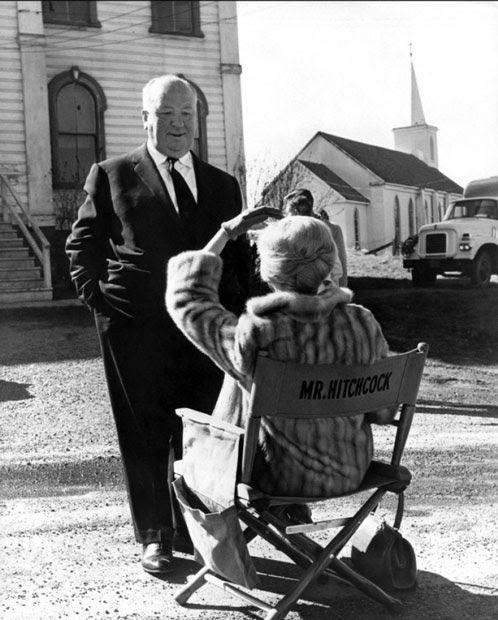
I've been a fan of Sienna Miller for a long time now, through both the highs (Interview; that time she cursed on The Today Show) and the lows (G.I. Joe; Balthazar Getty), so I was excited to read yesterday that she's going to be playing Tippi Hedren in a BBC drama called The Girl about Hedren and Alfred Hitchcock's contentious relationship during the filming of The Birds. The basic story about what happened between Hedren and Hitchcock has been public knowledge for a while now -- basically, his quest to create his feminine ideal (the "Hitchcock blonde") reached its zenith with Hedren, whom he discovered as a model and obsessively tailored into what he wanted until he fell in love with her, effectivly playing out the plot of Vertigo in real life -- but Hedren is apparently working with the producers of The Girl to show more of what actually occurred, which until now she's kept mostly to herself.

Miller has a tendency to put her foot in it no matter what she does, but I think she's a great choice to play Hedren, whose path to becoming an actress is not too different from her own (minus the obsessive impresario part, obviously). Miller also started her career as a model, and she's a much better actress than people tend to admit -- better, I would say, than her more successful British counterpart Kiera Knightley -- and, most importantly, it's not as if she's playing that other point of obsession for Hitchcock, Grace Kelly, a doomed role for an actress if ever there were one; she's playing a woman whose career kind of began and ended within the span of a few years and never became an icon like Kelly. Overall, The Girl sounds like it could be really good, especially with Toby Jones playing Hitchcock and Hitchcock's home country of England producing the picture.


Speaking of blondes, I'm about half-way through writing my reviews for TCM's Battle of the Blondes (which ended last week); in the meantime, I thought I'd dedicate a post to some of the famous blondes who didn't make the cut -- but should have. Maybe next year.


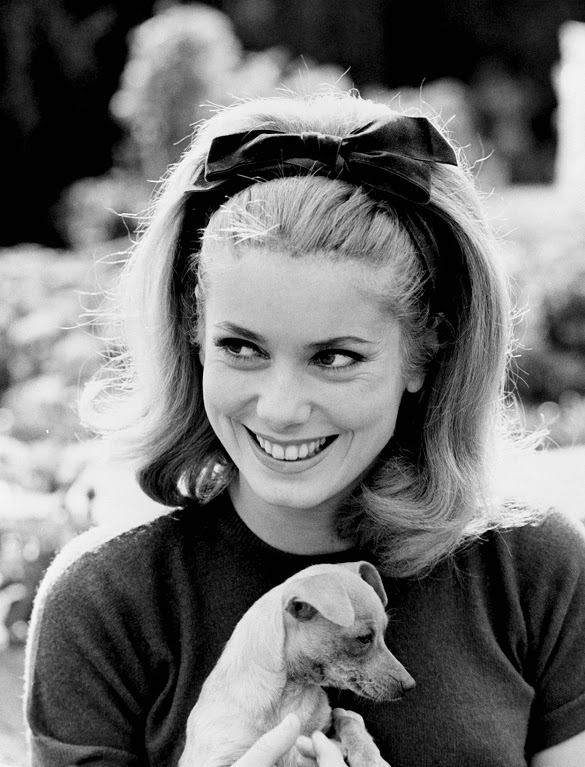
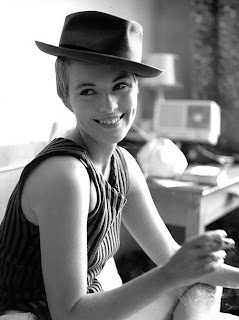
(from top to bottom, left to right: Constance Bennett, Catherine Deneuve, Glenda Farrell, Eva Marie Saint, Faye Dunaway, Joan Blondell and Ginger Rogers, Miriam Hopkins, Joanne Woodward, Jean Seberg)

Thursday, December 1, 2011

"Battle of the Blondes" Round Four: Marlene Dietrich vs. Ursula Andress


Pitting Marlene Dietrich against Ursula Andress is probably the most unfair fight in Battle of the Blondes, because I can't imagine any scenario in which Andress is going to win, except maybe a battle of who's still living. Andress was a Swiss actress who came to Hollywood during the fifties and made her big break in Dr. No (1962), playing the first Bond girl, Honey Rider; the scene in which we first see Andress emerging from the water in a white bikini in Dr. No is an iconic moment in mid-century cinema, but unfortunately, nothing Andress did thereafter lived up to that brief, wordless moment, and the closest she came to having a starring role was in She (1965), the film I chose to watch for Battle of the Blondes.

She, released by England's Hammer studio (usually associated with horror films), tells the story of an immortal woman in Africa who believes that a British soldier is her reincarnated lover of two thousand years past. Andress plays Ayesha, the immortal woman (and the "she" of the title), while John Richardson plays Leo, the soldier she seduces; Christopher Lee, star of Hammer's Dracula, has a supporting role as Ayesha's head priest Billali. Why Ayesha and Leo are white instead of black like every other African character in the movie is never explained, but She isn't the sort of film you want to think about too closely; you want to just watch it, and hope that your suspension of disbelief will be enough to keep the plot from falling apart all on its own. I'm not saying She is entirely without merit -- as expected, it succeeds mostly in the horrific aspects of the story, especially the ritual scene in which Leo almost loses his head, which is genuinely unsettling -- but the majority of the film is ridiculous, too self-serious to be campy and too silly to be effective. Richardson is really the star; Andress is only there to act as the centerpiece, looking pretty and wearing outfits reminiscent of what Cher would wear years later.

At the opposite end of the film spectrum is Josef von Sternberg's 1932 Shanghai Express, my choice for Marlene Dietrich. Shanghai is a bit like Grand Hotel on a train, with a disparate group of characters coming together and intertwining on a train bound from Peking to Shanghai before going their separate ways again after they reach their destination, but unlike Grand Hotel, in which much of the action derives from the personal relationships between the characters, Shanghai is set against the backdrop of the Chinese Civil War, and the climax of the story actually takes place off the train. Dietrich plays Shanghai Lily, a woman of dubious morals who survives by jumping from one man to the next; other passengers on the train include Lily's former lover Dr. Harvey (Clive Brook); fellow fallen woman Hui Fei (Anna May Wong); a rich American (Eugene Pallette); a pompous missionary (Lawrence Grant); and a mysterious half-Chinese/half-white revolutionary (Warner Oland).

Shanghai Express was Dietrich and Sternberg's fourth film together (after The Blue Angel, Morocco, and Dishonored), and as much as I liked The Blue Angel, I have to say that Shanghai is the best I've seen so far. Part of this estimation probably comes from my natural inclination toward movies with large casts contained in small places, derived from a youth spent reading old Agatha Christie mysteries, but Shanghai is also a genuinely great film. Dietrich is phenomenal, as are Wong, Oland, and Pallette, who, despite the generally serious tone of the film, made me laugh out loud several times. Sternberg made a star out of Dietrich with The Blue Angel, and Shanghai is the height of the image he crafted for her; she is thin, beautiful, and intimidating in this film, lit beautifully (I believe the picture of her above this review is from Shanghai Express) and directed in every way to enhance her reputation as an exotic femme fatale. Dietrich was somewhat of an alternative to Greta Garbo in the early thirties, but where Garbo was soft and tragic, Dietrich was more assertive and dangerous, sometimes harboring a heart of gold, sometimes not, and she plays her part to the hilt in Shanghai.

The interesting thing about Marlene Dietrich -- and I mentioned this briefly in my post on Conrad Veidt -- is that as much as she was sold as a wholly foreign entity at the beginning of her career, playing up her German-ness whenever possible, she was one of the strongest Hollywood supporters of the Allied cause during World War II and therefore managed to supersede that "foreign" quality and become a permanent USO fixture throughout the early forties, performing for US soldiers both at home and on the front lines in Europe. One of her most famous quotes was also her answer to why she put so much effort into supporting the troops: "aus Anstand" -- it was the decent thing to do.

She: C+
Shanghai Express: A+


(pic via here)

Thursday, November 24, 2011

"Battle of the Blondes" Round Three: Judy Holliday vs. Jean Harlow


One of the finest parts of Judy Holliday's Oscar-winning performance in Born Yesterday is also, unfortunately, one of the film's only drawbacks: Holliday is so spot-on in her portrayal of the educationally-deprived girlfriend of a corrupt businessman that she captures not only the humorous and occasionally charming side of stupidity, but also the aggravating, off-putting side, to the point that her Billie Dawn is rather unlikeable for the first third or so of the film. What Born Yesterday acknowledges is that truly stupid people are often unlikeable: they're rude, they're aggressive, they're strangely defensive of their own ignorance, and they're nothing like the lovable ditzes or airheads Hollywood usually portrays. Billie Dawn is less confrontational with her stupidity than her shady boyfriend Harry Brock (played by Broderick Crawford), but when we first meet her, she has a perpetual look of blank boredom on her face, as if she literally has nothing going on in her head except maybe a few sparks of mild discontentment, though she certainly couldn't be bothered to figure out why. Is it any coincidence that she shares her real first name, Emma, with the stupid, restless heroine of Gustave Flaubert's Madame Bovary?

What makes Billie Dawn different from Harry, however, is that she does want to learn, and it is within that desire that she quickly wins us over. Holliday is at her best in the scene when Billie, under the book-reading tutelage of newspaper man Paul Verrall (William Holden), begins to see both herself and Harry in a different light, her newfound intelligence both a boon to her self-esteem and a curse, because, of course, with knowledge comes the responsibility to actually use her mind rather than turning a blind eye to things she knows are wrong. Holliday, a theatre actress, originated the role of Billie on stage during the late forties, but she almost lost out on the part when it moved to the screen: Columbia wanted Rita Hayworth to play Billie, and it wasn't until Holliday gained attention in a supporting role in the Tracy-Hepburn comedy Adam's Rib that she seemed like a viable alternative. Looking at the movie now, of course, it's hard to picture anyone else playing the role, especially since Holliday ended up playing variations of Billie throughout the remainder of the fifties. That she won an Oscar for playing Billie is also a testament to how well she understood the part, not because an Oscar is necessarily the be-all and end-all in actor validation but because the Best Actress category in 1950 was especially stacked: in addition to Holliday, there was Eleanor Parker for Caged, Bette Davis and Anne Baxter for All About Eve, and Gloria Swanson for Sunset Boulevard, one of the most formidable row of performances that category has ever seen.

Jean Harlow, Holliday's competition in the third round of Battle of the Blondes, also made a name for herself playing secretly-smart dumb blondes, but she also had a vampish, glamorous side to her screen persona, and she uses -- and satirizes -- both of those images in the 1933 comedy Bombshell. Harlow plays movie star Lola Burns, a flighty but basically good-hearted woman trying to support her eccentric family and battle a rumor-mongoring studio publicity man (Lee Tracy) while looking for romance first with a Marquis, then a Boston society man (Franchot Tone). The character of Lola was largely based on twenties film star Clara Bow, but Harlow lampoons herself as well, reshooting scenes from Red Dust while flirting with the marquis (a reference to the real film she made with Clark Gable in 1932) and posing for hack magazine photos while pretending to boil a potato. Bombshell is heavy on Hollywood in-jokes and light on actual story, but Harlow is wonderful in it, and Tone is funny in a wink-wink nod to sentimental Hollywood romance.

Many people consider Jean Harlow to be the original blond superstar, which of course is technically not true, as both Marlene Dietrich and Constance Bennett (among many others) predate her in terms of being big stars who happened to have blond hair, but Harlow may well have been the first actress to become famous in part because of her blond hair. Her entire image, from her white-blond dye job to her dark eyeliner, was an essential part of her fame, and she more or less maintained her look for the duration of her career (she died unexpectedly in 1937 from uremic poisoning brought on by kidney failure). The funny thing about Jean Harlow is that, by today's standards, she is not typically what we think of as a really beautiful woman -- she has a rather large forehead, and her penciled-in eyebrows look a little alien -- but she was a major sex symbol in her day, and the sum total of her appearance still translates, as does her sense of humor and the way she fires off her dialogue in that voice that swings from high-class to low-class at will. She and Holliday have that in common (though Holliday's voice goes nasally in a way Harlow's rarely does), and it's possible to look at the type of characters Holliday played as the natural successor to the characters played by Harlow, a little less independent after World War II and the move toward conservatism in the late forties, but still lovable, and still capable of great insight when given half a chance.

Born Yesterday: A
Bombshell: B

Thursday, November 17, 2011

"Battle of the Blondes" Round Two: Veronica Lake vs. Lana Turner


Just as with Marilyn Monroe and Jayne Mansfield, comparing Veronica Lake and Lana Turner is more difficult than it initially seems, because aside from their common hair color and their status as pin-up girls during World War II, they don't actually have a lot in common. Lake's career more or less began and ended within the forties, while Turner maintained starring roles from the late thirties until the late sixties, and although both had shaky off-screen lives, Turner's was far more notorious, culminating with the 1957 murder of her gangster boyfriend by her teenage daughter; moreover, despite playing similar femme fatale roles during the forties, Turner had a more varied career overall, playing ingenue roles in the thirties and taking parts in soapy melodramas (Peyton Place; Imitation of Life) as she neared middle age. Ironically, Lake is probably better known today because of her iconic hairstyle, but like many of her contemporaries who became famous for particular looks or aspects of their images, her filmography only briefly mirrored her level of fame.

Watching a Veronica Lake movie can be a surprising experience, because despite her va-va-va-voom reputation today, she really doesn't act or come across that way in her films. She is pretty, certainly, and her peekaboo hairstyle gives her an air of mystery, but there is rarely anything overtly sexual about her roles; rather, she has a hard, reserved quality that says "bitch" more than it does "seductress." She is tiny, for one thing, a far cry from other voluptuous pin-up girls, and even when she's letting her hair down, she doesn't seem like the kind of girl who really knows how to have a good time. As she herself said, "I wasn't a sex symbol; I was a sex zombie." Part of this on-screen quality probably came from her off-screen personality, where she was allegedly extremely difficult to work with, to the point that Joel McCrea, her costar in Sullivan's Travels, refused to ever work with her again, saying, "Life's too short for two films with Veronica Lake."

If I sound like I dislike Veronica Lake, I don't; I think she brought a unique quality to movies in the early forties, and in most instances I think she was the perfect person to play the parts she was given, as in The Blue Dahlia, the movie I watched for Battle of the Blondes. The Blue Dahlia was Lake's third film with her most frequent costar, Alan Ladd, and tells the story of a soldier who returns from World War II and finds himself accused of murdering his unfaithful wife. (Lake plays the woman who helps Ladd try to prove his innocence.) Lake and Ladd were initially paired because she was the only actress short enough to make him look tall on screen, but they ended up being a good match because of their shared remoteness, an almost disenchanted quality that fits the tone of a post-war film perfectly. The Blue Dahlia is a tightly-paced, exciting film, featuring a genuine "whodunit?" mystery and a strong performance by Bill Bixby as one of Ladd's fellow soldiers. Lake doesn't have a lot to do, but she is effective nonetheless, especially in the scene where Bixby's character starts to have a flashback -- an instance where her tendency to underact serves her well.

My Battle of the Blondes choice for Lana Turner, meanwhile, was a completely different sort of film, a (mostly) light comedy released in 1939 entitled These Glamour Girls. Turner became a star with her very first film, 1937's They Won't Forget, but Glamour Girls was her first lead role, playing a taxi dancer who accompanies a rich boy to his college's weekend bash. (That's taxi dancer, not taxi driver, as I originally thought when I read the description of the movie; a taxi dancer is -- or was -- a girl who works in a dance hall as a professional dancer, dancing on a dance-by-dance basis with the male patrons, who buy her time with tickets. It was a popular profession to portray in the movies during the thirties and forties.) Glamour Girls is better than it ought to be, mostly because it's populated by talented actors that, in addition to Turner, include Lew Ayres, Jane Bryan and Marsha Hunt, but it also isn't as good as it could have been: Jane Bryan, as a debutante trying to keep up appearances despite her family's dwindling fortune, was clearly capable of a lot more, and Marsha Hunt's storyline as a pitiful party girl past her prime at the age of twenty-three ends in a spectacularly melodramatic fashion, yet is neither commented upon nor even noticed by the other characters. (I won't say what the melodramatic end is, but if you look at the screen shot of Hunt below, I bet you can guess.)


Turner is warm and friendly in These Glamour Girls, yet I never quite lost the feeling that someone who looks like her would never be intimated by a group of rich girls -- or need a job as a taxi dancer. (For the record, her hair is actually red in this movie; it wasn't until the early forties that she became known as a platinum blonde.) She really is beautiful, and she wears a strikingly modern-looking halter dress for most of Glamour Girls, but many classic movie actresses were beautiful, and I never get much else out of Turner's performances. She's good, but I've yet to see her be great, even in The Postman Always Rings Twice. She's icy in a different way than Lake, in a more superior way, as if she knows she's pretty and doesn't have a lot of time for people who aren't, and while I liked These Glamour Girls and her in it, I have to wonder if it would have been better with a different lead actress, or even if Turner's and Bryan's roles had been reversed.

The Blue Dahlia: A-
These Glamour Girls: B

Sunday, November 6, 2011

"Battle of the Blondes" Round One: Marilyn Monroe vs. Jayne Mansfield


I'm not going to do reviews for Battle of the Blondes the way I am for Summer Under the Stars, but I am watching two films for each night, one for each actress featured, and for the Monroe and Mansfield showdown I watched Niagara (Monroe) and Will Success Spoil Rock Hunter? (Mansfield) -- which, right off the bat, I'll acknowledge is not really a fair fight. Niagara is a middling film at best, really only worth watching for Monroe's presence and the impressive shots of the Falls, while Will Success Spoil Rock Hunter? is a clever satire featuring Mansfield in a part she had honed on stage before bringing to the screen. If I'm judging film-versus-film or even performance-versus-performance, Mansfield wins, hands down.

To compare Monroe and Mansfield on a broader basis is trickier, though, because they're not actually as much alike as they initially seem (or appear). I can't explain Marilyn Monroe any better than anyone else can, but she was an original, whatever she was, and it's true that the Jayne Mansfield we know probably couldn't have existed without Monroe preceding her, because part of Mansfield's persona is a second-rate Monroe impersonation -- but not her entire persona. Mansfield sometimes seems like she's purposely parodying Monroe to get laughs and other times seems like she's just copying Monroe outright; the truth is probably somewhere in the middle, especially in her earlier films like Will Success Spoil Rock Hunter? The main difference between Monroe and Mansfield is in that ambiguity: Monroe was an enigma, but she was also always herself and entirely free of irony; her depth came from the way she combined sex and naivete in a way no one has really been able to replicate since she died. Modern viewers sometimes complain that they want to hear Monroe speak in her "real voice" or play someone other than "Marilyn Monroe," but eventually we all have to accept that she either wouldn't or couldn't, because the line between Marilyn and Norma Jean dissolved early in her career, if it ever existed in the first place.

No one ever has to wonder what Jayne Mansfield's real voice sounded like; she used it just as often as she cooed and squeaked and sang her words. She modulates her voice in a way Monroe never does, switching from normal to husky to girlish in the span of one sentence, and then back again, parodying herself, parodying Monroe, parodying the idea of a blond bombshell in general. We know she's playing a part, and she knows she's playing a part, too, which is probably why every inch of her appearance is more than Monroe: her breasts are bigger, her hair is bigger, her makeup is thicker. Her brain might well have been bigger, too -- she claimed to have an IQ of 163, and who knows if that's true, but she seems more intelligent than Monroe, delivering her lines with a winky quality entirely absent from Monroe's body of work. Where Monroe was a blank slate, Mansfield has activity behind her eyes, which can be both a blessing and curse: she seems cruder than Monroe because she knows every angle of what she's doing, but she's also never pitiful...because she knows every angle of what she's doing.

In the end, it's hard to pick a winner between Monroe and Mansfield because their effect on screen is entirely different. Rock Hunter aside, Monroe is the easy choice because she had a greater number of good roles and because, well, she's Marilyn Monroe, but to hand her the win over Mansfield for those reasons is no more fair than to judge her solely on Niagara. To compare the two of them really is like comparing apples and oranges, and I have a feeling most of the showdowns in Battle of the Blondes are going to feel the same way, which is why I'm going to just stick to talking about the actresses rather than picking winners. Chances are good I'll just end up picking my personal favorites anyway. I will, however, gladly rate the movies, and since I've already spent enough time comparing Monroe and Mansfield, suffice it to say that Niagara is an ill-defined noir with better scenery than storytelling, and Will Success Spoil Rock Hunter? a genuinely funny comedy about the advertising world during the late fifties, like Mad Men with a good dose of levity. Skip Niagara unless you're a big Monroe fan (or a big fan of the Falls); see Rock Hunter if you simply want to be entertained.

Niagara: C+
Will Success Spoil Rock Hunter?: A

Wednesday, November 2, 2011

Battle of the Blondes

This month on TCM, rather than picking one actor to feature as their Star of the Month, they're doing a "Battle of the Blondes" spectacular, pitting two blond actresses from the classic movie era against each other every Monday and Wednesday night throughout November. The logistics of the Battle of the Blondes concept is a little wonky, considering almost every actress from the thirties was blond at one point or another, but overall the idea is pretty cool, and different from the usual TCM scheduling fare. The first battle of the month commences tonight, between 50s' pinup blondes Marilyn Monroe and Jayne Mansfield, and below is the schedule for the rest of the month.


Wednesday, November 2 -- Battle of the Pinup Blondes: Marilyn Monroe vs. Jayne Mansfield


 Monday, November 7 -- Battle of the Icy Blondes: Veronica Lake vs. Lana Turner


Wednesday, November 9 -- Battle of the Brassy Blondes: Judy Holliday vs. Jean Harlow


Monday, November 14 -- Battle of the European Blondes: Marlene Dietrich vs. Ursula Andress


Wednesday, November 16 -- Battle of the Wisecracking Blondes: Carole Lombard vs. Mae West


Monday, November 21 -- Battle of the Postmodern Blondes: Janet Leigh vs. Brigitte Bardot


Wednesday, November 23 -- Battle of the Chipper Blondes: Betty Grable vs. Doris Day


Monday, November 28 -- Battle of the British Blondes: Julie Christie vs. Diana Dors


Wednesday, November 30 -- Battle of the Hitchcock Blondes: Grace Kelly vs. Kim Novak